
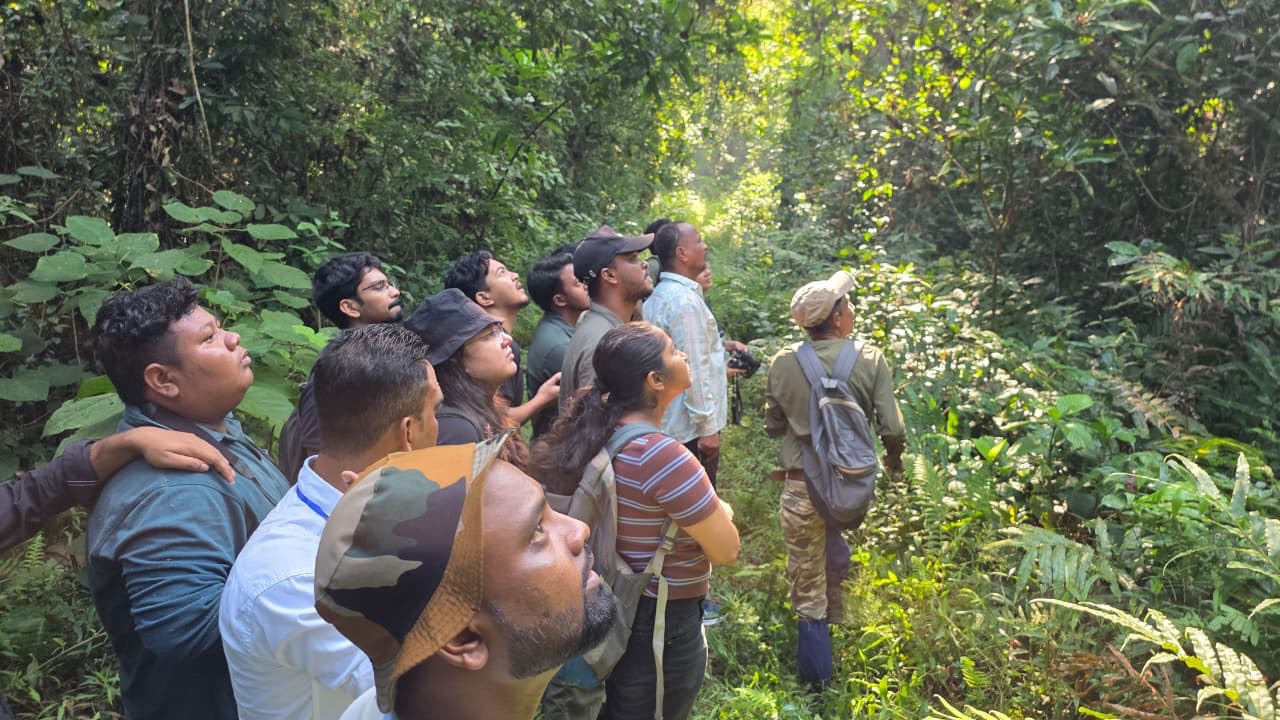
The third edition of Primate Watch was successfully held at the Hollongapar Gibbon Sanctuary drawing 19 participants from diverse academic and professional backgrounds to promote awareness and engagement in primate conservation. The programme placed special emphasis on the Western Hoolock Gibbon, the only ape species found in India.
Participants included students, professionals, a medical practitioner, a faculty member from Mariani College, and staff members of Aaranyak’s Primate Research and Conservation Division. The initiative aimed to enhance understanding of primate conservation, raise awareness about the challenges faced by primate species, and encourage active public participation in conservation efforts.
The event began with a welcome session and participant introductions. Dr. Dilip Chetry, Director and Head of Aaranyak’s Primate Research and Conservation Division, delivered an informative presentation on primates, the threats affecting their survival, and the conservation measures needed to protect them. He also highlighted the ecological importance of the Western Hoolock Gibbon.
A major attraction of the programme was a two-hour trek through the sanctuary, during which participants observed wildlife in its natural habitat. The group successfully spotted a troop of Western Hoolock Gibbons as well as a group of Rhesus Macaques. The Hollongapar Gibbon Sanctuary is home to seven primate species, making it a key site for research, conservation, and public awareness.
Following the field visit, participants took part in an interactive discussion, sharing their observations and experiences. Many expressed interest in becoming more actively involved in future conservation initiatives alongside Aaranyak, emphasizing the value of hands-on learning and direct exposure to wildlife.
To mark their participation and reinforce the message of wildlife conservation, attendees received certificates, posters, and stickers featuring the Western Hoolock Gibbon.
The programme concluded with a vote of thanks by Dr. Dilip Chetry, who appreciated the enthusiasm and contributions of all participants.
Primate Watch 3.0 reaffirmed the importance of public engagement and experiential learning in strengthening support for primate conservation. By connecting people directly with wildlife and their habitats, the initiative seeks to inspire informed action and long-term commitment to protecting the Western Hoolock Gibbon and other primates of Northeast.