
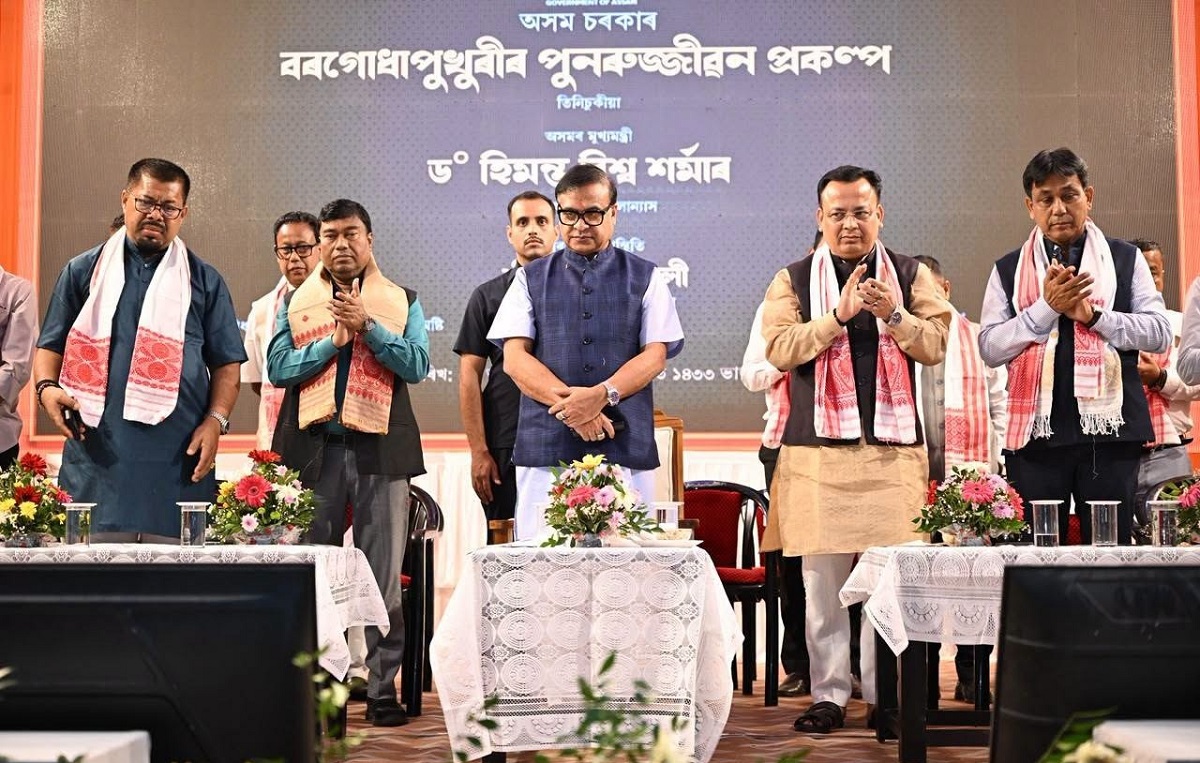
Assam Chief Minister Himanta Biswa Sarma has announced an allocation of Rs 200 crore for improving roads and drainage systems in Tinsukia and Rs 50 crore for the construction of a modern auditorium, as the state government steps up efforts to upgrade infrastructure in the commercial town.
The announcements were made on October 28 during a programme at Manab Kalyan Puja Bhawan in Tinsukia. The chief minister laid the foundation stones for four municipal infrastructure projects worth Rs 8 crore under the 15th Finance Commission and launched Samagra Seva, an integrated digital application developed at a cost of Rs 1.50 crore to improve residents’ access to civic services.
Addressing the gathering, Sarma said Tinsukia was one of Assam’s major commercial centres and historic towns and had made significant contributions to the state’s economy over the years. However, acknowledging concerns about the town’s development, he said the government had taken steps to address infrastructure gaps and accelerate urban growth.
The chief minister identified roads and drainage as two of the town’s major requirements. The proposed investment of Rs 200 crore is intended to support the construction and improvement of road networks and drainage infrastructure, which are essential for better connectivity, traffic movement and the delivery of civic services.
Sarma also announced plans to construct an integrated District Commissioner’s Office to bring various district-level government offices under one roof. The proposed facility is expected to make administrative services more accessible and convenient for the public.
Another major announcement was the construction of a modern auditorium with a seating capacity of 1,000 people at an estimated cost of Rs 50 crore. The facility is expected to provide space for meetings, conferences, cultural programmes and other public events, adding to the town’s civic and cultural infrastructure.
Other proposed development works include a new bus terminal, a multi-level car parking facility, the upgradation of Kachujan Stadium, the modernisation of the district library and the installation of streetlights across Tinsukia town.
The chief minister said the government’s development plans would extend beyond the projects announced at the programme, indicating that further initiatives would be taken to improve the town’s infrastructure and public amenities.
The four projects for which foundation stones were laid are being undertaken by the Tinsukia Municipal Board with funding under the 15th Finance Commission. They form part of the wider effort to strengthen municipal infrastructure and improve facilities for residents.
Sarma also referred to ongoing development works at Shaheed Piyoli Phukan Playground, where Rs 4.54 crore has been earmarked for development and beautification. The rejuvenation of Bar Godha Pond is being undertaken with an allocation of Rs 2.33 crore. In addition, beautification work has been taken up at Mahatma Gandhi Park and Bishnu Rabha Park.
These projects are aimed at improving public spaces and recreational facilities in the town, while making existing parks and water bodies more accessible and attractive for residents.
Alongside physical infrastructure, the state government is also seeking to improve the delivery of municipal services through digital technology. At the programme, Sarma launched Samagra Seva, an application designed to bring various civic services onto a single digital platform.
Developed at a cost of Rs 1.50 crore, the application will integrate sanitation services and other municipal facilities, allowing residents to access services through their smartphones without having to visit the municipal office for routine work.
Through the platform, residents will be able to track waste collection vehicles in real time, pay property taxes, apply for trade licences, seek construction permits and access other municipal services. The facility is expected to reduce the time and effort required to complete civic transactions while making municipal administration more accessible.
The application is also intended to improve the coordination of sanitation services by enabling residents to monitor waste collection vehicles. This could help people obtain information about waste collection and make it easier to follow up on municipal services.
Sarma said the government would also work towards establishing a university and an engineering college in Tinsukia following the construction of a medical college in the district. The proposed educational institutions would expand opportunities for higher and technical education and could reduce the need for students to travel to other cities to pursue certain courses.
Referring to the Bharatiya Janata Party’s victories in the Assembly constituencies of Tinsukia district in the last election, the chief minister said the government would seek to respond to the public’s support through further development initiatives.
The announcements mark a broader infrastructure push in Tinsukia, covering roads, drainage, public transport, parking, education, recreation and digital municipal services. The implementation of these projects will be important in determining how quickly residents benefit from the proposed improvements.