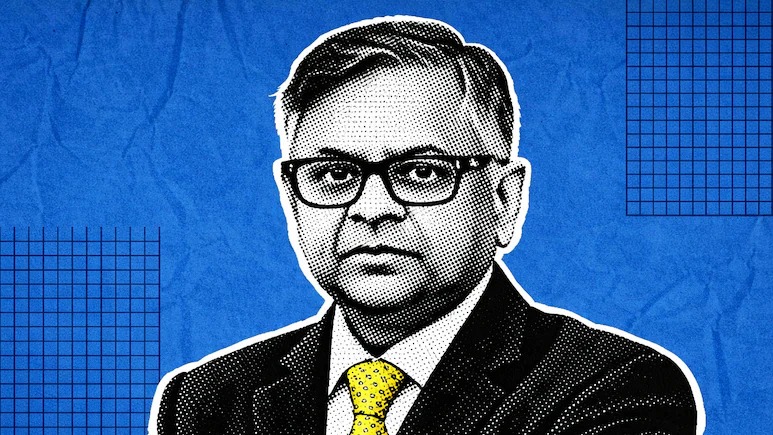
Tata Consultancy Services Chairman Natarajan Chandrasekaran has said that generative AI and agentic AI are entering a transformative phase where artificial intelligence is becoming the “infrastructure of intelligence” for businesses worldwide.
In his letter to shareholders in the TCS Annual Report FY26, Chandrasekaran highlighted the company’s growing focus on becoming a full-stack AI services provider as enterprises increasingly shift from experimental AI projects to large-scale implementation.
“AI is now becoming the infrastructure of intelligence. It will influence how enterprises invest, organize supply chains, manage risk, and serve stakeholders,” Chandrasekaran stated. “Customers will move from pilots to scale, embedding AI into core functions.”
The comments come as TCS accelerates its push into AI-driven services and infrastructure, positioning itself as a major player in the rapidly evolving enterprise AI ecosystem.
According to the company, TCS closed FY26 with annualised revenue of $2.3 billion from AI services and $11.5 billion from new-age digital businesses including cloud computing, cybersecurity, enterprise solutions, and data services. The company’s total revenue for FY26 stood at $30 billion, while total contract value for deals signed during the year reached $40.7 billion.
Chandrasekaran said TCS is repositioning itself as an “AI and Digital Transformation partner” and significantly expanded its “Human+AI” operating model during the fiscal year. The company also scaled its industry-specific AI agent marketplace initiatives aimed at enterprise automation and intelligent workflow management.
As part of its broader AI strategy, TCS entered the data centre business during FY26 and acquired multiple firms to strengthen its AI-adjacent capabilities.
The company also launched HyperVault, an AI infrastructure platform developed in partnership with TPG. Chandrasekaran noted that growing global constraints around power, computing resources, and geographic concentration are creating new opportunities for India to emerge as a strategic destination for AI infrastructure development.
“HyperVault positions us at the centre of this shift,” he said.
TCS is currently constructing what it describes as India’s first AI-focused high-density data centre, featuring rack densities exceeding 160 kilowatts. The facility is expected to support advanced AI workloads and large-scale computing demands associated with generative AI systems.
The company also acknowledged the broader economic and geopolitical uncertainties affecting global markets, including tensions in West Asia, supply chain disruptions, and concerns over stagflation.
“We are in the midst of intensifying geopolitical tensions, shifts in trade and supply chains, and uneven economic growth. Across markets, corporates are prioritising resilience, productivity and trust-based decisions,” Chandrasekaran said.
Meanwhile, TCS Chief Executive Officer and Managing Director K Krithivasan described FY27 as a pivotal year for the company’s AI ambitions.
“To realise the opportunities offered by AI, we set out a bold aspiration to become the world’s largest AI-led technology services company,” Krithivasan said.
He explained that TCS plans to strengthen its “Infrastructure to Intelligence” strategy by building industry-specific AI systems, expanding partnerships, and establishing secure sovereign AI infrastructure.
Krithivasan added that TCS aims to position itself as an “Enterprise Intelligence Integrator,” helping organisations modernise software systems, embed AI agents into business operations, and manage data governance and cybersecurity at scale.
The company’s aggressive AI expansion reflects the wider transformation underway across the global IT services industry, where major firms are rapidly adapting to growing enterprise demand for generative AI tools, intelligent automation, and AI-native infrastructure solutions.