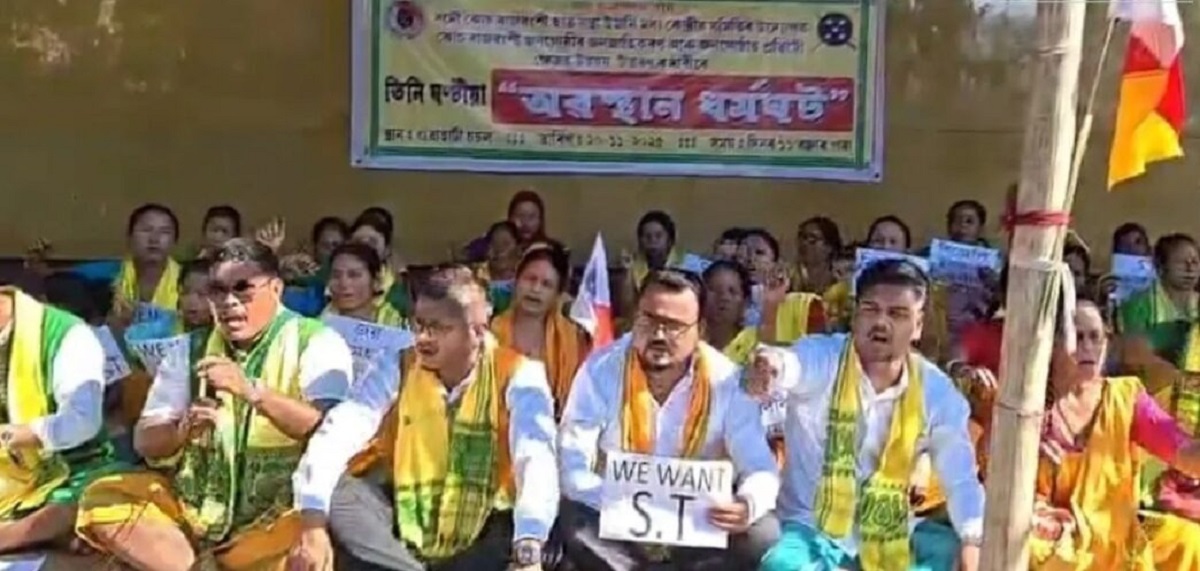
The United People’s Party Liberal (UPPL) suffered a major setback on Sunday after several central and district-level leaders of the Koch Rajbongshi community resigned en masse, accusing the party of failing to take a decisive stand on their long-pending demand for Scheduled Tribe (ST) status.
The decision was finalised at a meeting held in Sidli, Chirang district, where leaders stated that all Koch Rajbongshi members associated with UPPL would gradually step down. Central committee members, along with block and district representatives, submitted their resignations on Sunday, with others expected to follow in the coming days.
UPPL CWC member, Kusumbar Choudhury said the community had anticipated a clear position from the party after the ST status proposal was raised in the Assembly.
“Many communities are protesting for ST status. It is our democratic right to do so. Since we are associated with UPPL, we wanted the party to clearly express its stand. But when the president spoke a few days ago, people found his statement impartial,” Choudhury said.
He added that prominent Koch Rajbongshi organisations, including Kamatapur Liberation Organisation-Kochan Nationalist (KLO-KN), and All Koch Rajbongshi Students’ Union (AKRASU) had urged community members within UPPL to resign.
“Honouring their appeal, we discussed the matter and decided that all Koch Rajbongshi members will sign their resignations. Today, members of the central committee and block and district representatives submitted theirs, and others will follow,” he said.
Choudhury termed the recent violence in Kokrajhar—where tribal groups protested granting ST status to six communities—“an unfortunate incident”, emphasising that the issue must be resolved democratically.
UPPL central secretary Sribas Barman, who was also present at the press meet, echoed similar sentiments, stating that the leadership failed to offer a “proper clarification” on the matter.
“We are resigning collectively because the party president did not clarify his position. AKRASU, KLO-KN and local community members have supported our decision.
We request the government not to ignore this demand like previous years or use it as a lollipop before the 2025 Assembly elections,” Barman said.
He urged both the state and central governments to “immediately resolve the issue and grant ST status” to the Koch Rajbongshi community. Condemning the Kokrajhar clashes, he stressed that protests must be peaceful and avoid confrontation with existing ST communities.
Leaders said all Koch Rajbongshi workers and office bearers within the UPPL are expected to resign in phases, marking a significant political shift in the Bodoland Territorial Region.
The development comes at a time of heightened tensions following tribal groups’ opposition to the inclusion of six communities under the ST category.
Meanwhile, strong resentment has erupted after the ministerial committee submitted its report on granting Scheduled Tribe (ST) status to six communities of Assam. At a press conference, the All Koch-Rajbongshi Students’ Union (AKRSU) alleged that the report attempts to divide the Koch-Rajbongshi community into two separate categories. The organisation warned that the recommendations have “ignited public anger” and declared, “If our hearts burn, we will burn Janata Bhawan.”
The protestors demanded that the report be withdrawn immediately, terming it discriminatory and unacceptable.
AKRSU drew parallels with ongoing electoral roll revisions elsewhere in India. After Bihar, the Election Commission of India has initiated Special Intensive Revision (SIR) of electoral rolls in 12 States and Union Territories, including Chhattisgarh, Goa, Gujarat, Kerala, Madhya Pradesh, Rajasthan, Tamil Nadu, Uttar Pradesh, West Bengal, Andaman & Nicobar Islands, Lakshadweep and Puducherry. However, in Assam only a Special Revision (SR) is being conducted.
Quoting past official assessments, the petitioners noted that former Assam Governor Lt. Gen. S. K. Sinha had informed the Centre that 40–50 lakh illegal immigrants were living in Assam. Former Union Home Minister Indrajit Gupta had echoed similar concerns, and the Supreme Court too had expressed alarm during hearings related to the IMDT Act and the Sarbananda Sonowal case.
According to the objections raised, during Special Revision, electors are not required to submit any documents to prove citizenship, whereas Special Intensive Revision mandates documentary proof for inclusion in the voter list. Given Assam’s long-standing issue of illegal immigration, they argued, limiting the State to a simple SR process while other States undergo SIR is discriminatory and unjustified.